The modern workplace cannot be identified as comprising a particular era or a particular frame of mind. In the modern organizational setting, we can identify an ecosystem comprising people from the Baby Boomer generation, Gen Xers, millennials, and Gen Zers. There are resultant challenges associated with the varying eras and mind-sets that can only be bridged through a reverse mentoring program. A reverse mentoring program is specially tailored with the intention of creating a two-way flow that contrasts with the traditional mentoring program.
Glimpse of Reverse Mentoring and Multigenerational Work
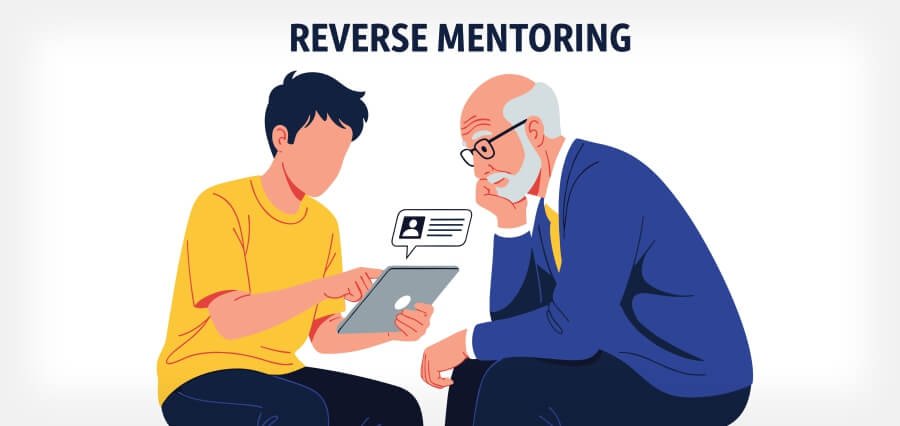
A reverse mentoring program is one that is formally developed to involve a reverse mentoring format, as in a multi-generational work setting, it is recognized that the flow of learning does not always need to be one-sided. New employees are likely to have unique perspectives on technology, technology-based culture, social directives, and work innovations, while their seniors are likely to possess strategic, organizational, and leadership know-how.
This system works especially well because it challenges hierarchy without abandoning power structures. Replacing the notion that age equates to expertise with reverse mentoring means looking at the issue in relation to relevance. Relevant information and trends have a tendency to come and go in the workplace due to the diversity and various age levels in the workforce.
Why Reverse Mentoring Matters in a Multigenerational Workforce
Within diverse teams, a large cause of friction comes from the quiet generation gap between the senior members and their younger colleagues. The senior members often do not understand motives, values, and working styles, and the younger members often feel ignored. Thus, a reverse mentorship is a healthy environment where such involvements could naturally occur.
If a mentee from Gen Z is helping an old and experienced leader or a high-ranking member in an organization learn about their tastes when it comes to matters relating to social media, for instance, such a scenario humanizes both the mentee and the mentor. The latter gets to know the pulse of the mind of the generation that is coming after theirs, while the mentee gets to gain self-confidence by learning from someone they know runs an organization.
Enhancing Leadership through Reverse Mentoring
These programs are a powerful engine for developing leadership talent within multigenerational environments. For example, leaders who participate in reverse mentoring have characteristics such as flexibility, empathy, and willingness to adapt to new trends. They learn directly from the staff how the culture is changing, what employees are demanding, and the emergent technology trends, among other issues.
For younger colleagues, mentoring senior leadership is also incredibly transformative because, by moving faster, these young individuals learn about the pathways that lead to certain choices, how strategy is developed, and obstacles that come with an organization. This is incredibly advantageous, especially regarding leadership positions, as senior leadership also realigns these individuals to understand that, indeed, their voices are being heard. This is especially important in a multigenerational team.
Reverse Mentoring to Spur Cultural Change
Beyond competencies, reverse mentoring quietly changes the personal climate of an organization inside and out. Across generations, culture stalls when one generation dominates while others feel ignored. Using reverse mentoring, that message is loud and clear: learning is ongoing and inclusive, no matter the age or title.
These programs tilt curiosity over judgment. Senior staff learn to ask questions instead of jumping to conclusions, while younger colleagues learn to express ideas with clarity and responsibility. Over time, the culture moves from command-and-control thinking toward collaboration and dialogue. In a multigenerational setting, that cultural alignment will be important for innovation, engagement, and retention.
The Outlook for Reverse Mentoring within the Multigenerational Workforce
As the workplace continues to evolve, reverse mentoring will feel less like an experiment and more like a necessity. The multigenerational dynamic is not a blip but a new normal. Long careers and fast tech changes mean organizations have to create systems where knowledge flows across generations.
The future of reverse mentoring is tied to integration, not isolation. Rather than being siloed to HR, these programs will be integrated into leadership development, onboarding, and talent management. This integrative approach, in a multigenerational diverse environment, helps keep learning abreast with change and ensures no generation is left behind.
In all, reverse mentoring is not some flash in the pan. It’s a hard-nosed response to multigenerational workforce realities. By tapping into the strengths of each generation and promoting mutual learning, organizations are better able to nurture resilient leaders and cultures of inclusivity, with teams ready for the future. When learning becomes everyone’s responsibility, rather than a top-down mandate, work becomes a place where experience and innovation grow up together.