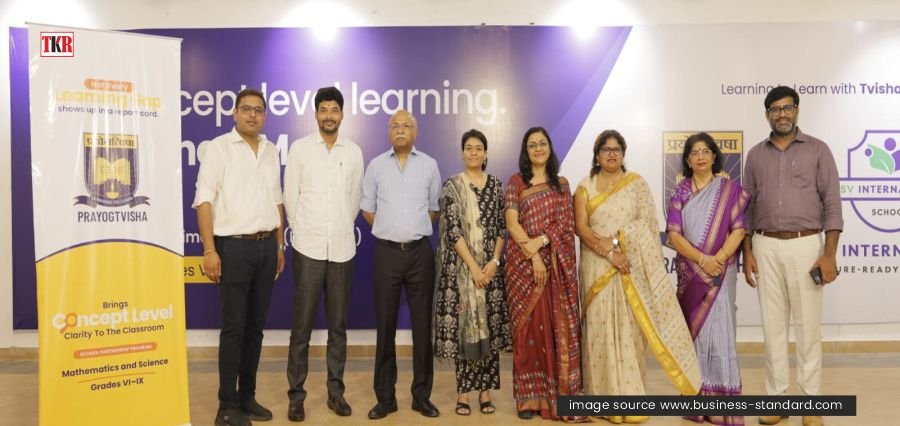
Prayogtvisha has launched a pilot STEM education programme at SSV International School in Guntur, introducing a concept-based approach to teaching science and mathematics for students in Grades 6 to 9. The initiative aims to improve learning outcomes by moving beyond rote memorization and helping students develop a deeper understanding of core concepts through structured lessons, practical activities, and continuous assessment.
Founded by Menterra Social Impact Fund, Prayogtvisha focuses on strengthening STEM education by equipping schools with teaching methodologies that emphasize comprehension, critical thinking, and real-world application. The pilot programme also aligns with India’s National Education Policy (NEP) and the National Curriculum Framework (NCF), supporting the country’s broader efforts to transform classroom learning through experiential education.
Concept-Based Learning Takes Priority
The Prayogtvisha programme is built around a structured teaching framework that introduces one concept at a time, ensuring students fully understand each topic before progressing further. Instead of relying solely on traditional examinations, the programme incorporates continuous assessments that identify learning gaps and provide timely support to strengthen conceptual understanding.
Students will also engage with specially curated learning materials designed to connect scientific and mathematical concepts with real-life situations. Hands-on activity kits, storytelling techniques, and interactive classroom exercises are integrated into the curriculum to make learning more engaging and meaningful.
Teachers participating in the programme receive ongoing professional development rather than one-time training sessions. They are supported with detailed lesson plans, instructional resources, classroom tools, and continuous mentoring to ensure effective implementation of the new teaching methodology. This approach recognizes that teacher development plays a central role in improving long-term student outcomes.
Along with STEM education, the programme incorporates the EFIL life skills curriculum, which helps students develop confidence, ethical decision-making, effective communication, and career awareness. This balanced approach enables them to strengthen their academic foundation while building the essential life skills needed for future success.
Supporting India’s Education Transformation
The pilot reflects a growing emphasis on improving foundational learning in science and mathematics across Indian schools. Education experts have increasingly highlighted the importance of conceptual clarity during middle school years, as strong fundamentals enable students to pursue higher education and careers in engineering, healthcare, research, technology, and other STEM-related fields.
By combining innovative teaching methods with continuous teacher support, the programme seeks to address learning challenges that often arise from memorization-based instruction. The model encourages curiosity, problem-solving, logical reasoning, and practical application, helping students become more confident learners.
The collaboration also demonstrates how partnerships between educational institutions and specialized education organizations can accelerate innovation within classrooms. As schools continue adopting learner-centered teaching models, structured STEM programmes are expected to play an increasingly important role in preparing students for future academic and professional opportunities.
Building Future-Ready Learners
As India continues investing in education reform, initiatives that strengthen STEM learning are becoming increasingly important for developing a future-ready workforce. Schools are placing greater emphasis on critical thinking, creativity, collaboration, and analytical skills that extend beyond traditional academic performance.
The Prayogtvisha pilot represents an important step toward making science and mathematics more accessible, engaging, and relevant for students. By empowering teachers with modern instructional tools and encouraging deeper conceptual learning, the programme aims to improve both classroom experiences and long-term educational outcomes.
If successfully implemented, the pilot could provide a scalable model for wider adoption across schools, contributing to stronger STEM education and better learning outcomes for students nationwide. As education systems continue evolving to meet future workforce demands, initiatives that combine innovative pedagogy with teacher development are expected to play a vital role in shaping the next generation of learners.
Read More: Rajouri Student Earns Global Recognition for AI-Powered Education Startup