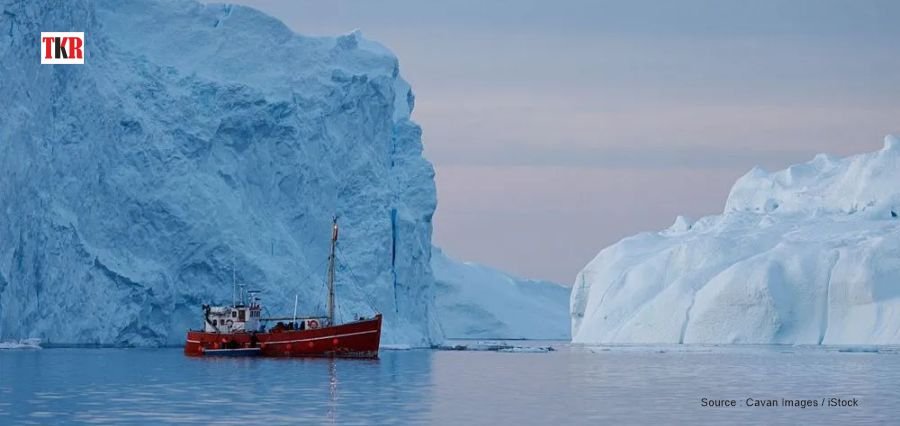
An international scientific and educational expedition has brought together 66 students from 22 countries for a remarkable 10-day journey to the geographic North Pole, providing young participants with firsthand experience in Arctic science, climate research, and global collaboration.
The expedition began in Murmansk, Russia, where students boarded the nuclear-powered icebreaker 50 Let Pobedy for a mission designed to inspire the next generation of scientists, engineers, and environmental leaders. Participants will engage in scientific activities while learning about the Arctic ecosystem, climate change, and advanced polar technologies.
The programme aims to combine education with practical experience by allowing students to work alongside scientists, researchers, and industry experts in one of the world’s most challenging environments. Throughout the voyage, participants will observe Arctic conditions, conduct experiments, and gain a deeper understanding of the region’s importance to the global climate system.
The expedition also promotes international cooperation by encouraging students from diverse cultural backgrounds to collaborate on scientific challenges and exchange ideas that could contribute to future environmental solutions.
Hands-On Learning in One of Earth’s Most Extreme Environments
The journey offers participants a rare opportunity to experience the Arctic firsthand while studying the effects of climate change in one of the planet’s most environmentally sensitive regions.
Students will participate in workshops, lectures, and research activities covering subjects such as polar ecology, oceanography, nuclear technology, renewable energy, and environmental sustainability. Scientists leading the programme hope the immersive experience will inspire many participants to pursue careers in science, technology, engineering, and mathematics (STEM).
The expedition also emphasizes teamwork and innovation. Working in multinational groups, students will develop problem-solving skills while gaining insight into how scientific collaboration helps address global environmental challenges.
Among the participants is Lucky Rawat, a student from Uttarakhand, who is representing India after being selected through a competitive multi-stage process. He is the country’s sole student participant in this year’s expedition.
Inspiring the Next Generation of Global Researchers
Beyond scientific discovery, the expedition is designed to foster international friendships and encourage greater awareness of global environmental issues.
Organizers believe exposing young people to real-world scientific research at an early stage can inspire future innovations in climate science, clean energy, and environmental conservation. The programme also demonstrates how international cooperation can play a vital role in addressing challenges that affect the entire planet.
As countries continue investing in scientific research and environmental sustainability, initiatives like this help prepare future leaders with the knowledge, practical experience, and collaborative mindset needed to solve increasingly complex global problems.
By combining education, exploration, and international collaboration, the Arctic expedition offers students an unforgettable learning experience while strengthening the global scientific community. The journey highlights the growing importance of engaging young minds in research that supports environmental protection, technological innovation, and a more sustainable future.